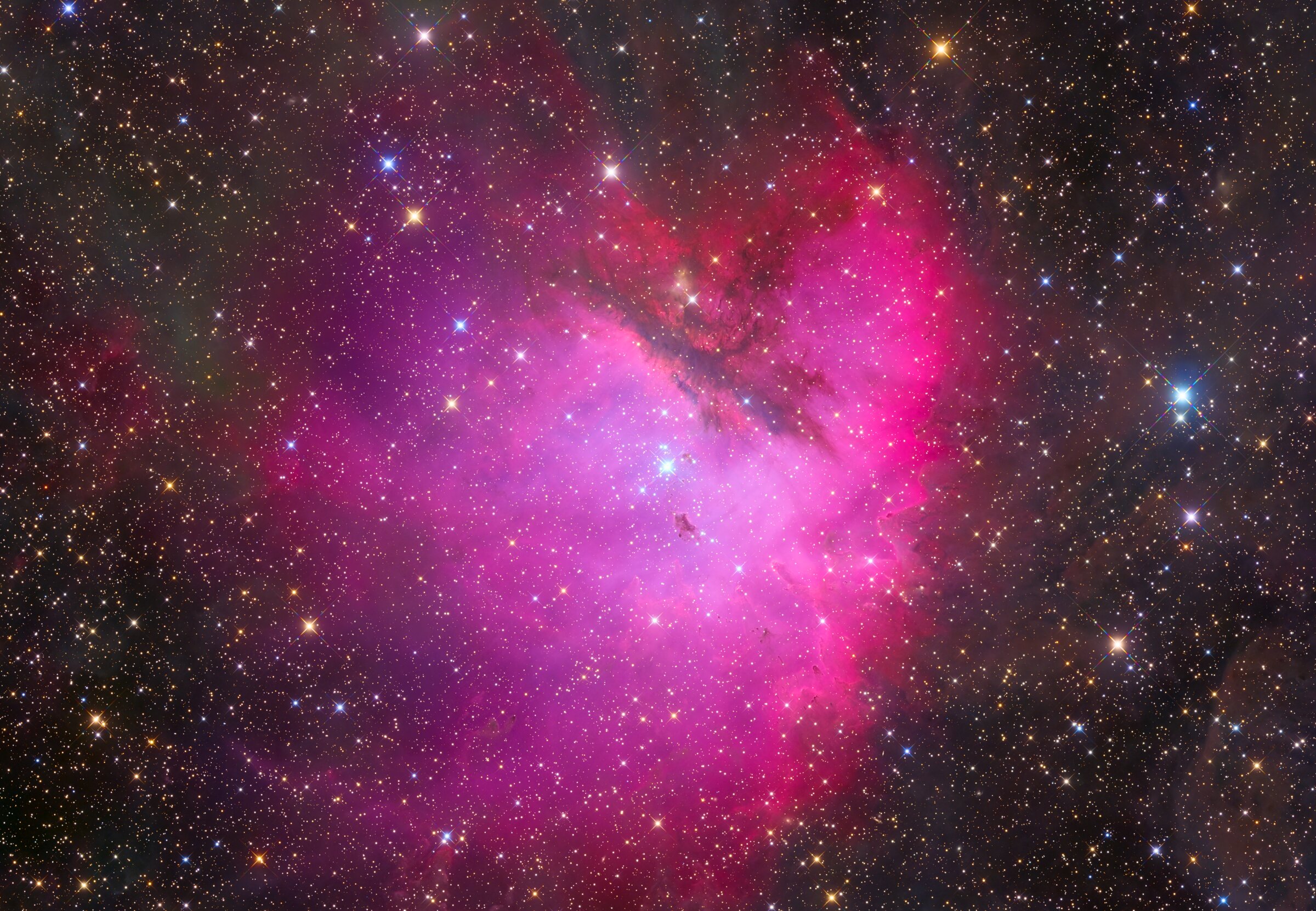
Glowing Silence – NGC 281 (Pac-Man Nebula)
What happens in this image is creation itself: stars are being born, gas clouds glow, and radiation slowly blows away the dark dust. All of it unfolds in complete silence, some 9,500 light-years away.
Glowing in the constellation Cassiopeia, NGC 281 is known among amateur astronomers simply as the Pac-Man Nebula. It owes its nickname to the dark dust lane that cuts into the bright body of the nebula, outlining a Pac-Man figure with its mouth wide open.
The glow comes from ionized hydrogen gas. The energy is supplied by the young open cluster IC 1590, at whose heart lies the multiple star system HD 5005, the bright, bluish-white group of stars at the center of the image. The radiation of these hot, massive stars makes the surrounding gas glow, while slowly dispersing the very cloud they were born from. The sharp, bright rim running along the right side of the nebula is the ionization front, where the radiation is biting into the cold molecular cloud.
Below and around the cluster, small dark knots can be seen: these are Bok globules. They are dense, cold spheres of dust and gas, inside which new stars are thought to be forming. The globules of NGC 281 are among the best known, and the Hubble Space Telescope has also photographed them in detail.
NGC 281 was discovered by Edward Emerson Barnard in 1883.
The photons for this image arrived on nights in September and October 2026. The original plan was the Hubble palette, but after capturing the RGB data, the plan changed :) Finding the right processing workflow and composition is far from easy with this object. Honestly, I'm not fully at peace with either of them, but I'm letting it go as it is for now :)
[ EXP ] Exposures
| Filter | Frames | Exposure | Gain | Total |
|---|---|---|---|---|
| L | 60 | 120 s | 100 | 2h |
| R | 20 | 180 s | 100 | 1h |
| G | 20 | 180 s | 100 | 1h |
| B | 20 | 180 s | 100 | 1h |
| Total | 120 | 5h |
[ PRC ] Processing
PixInsight, BlurXTerminator