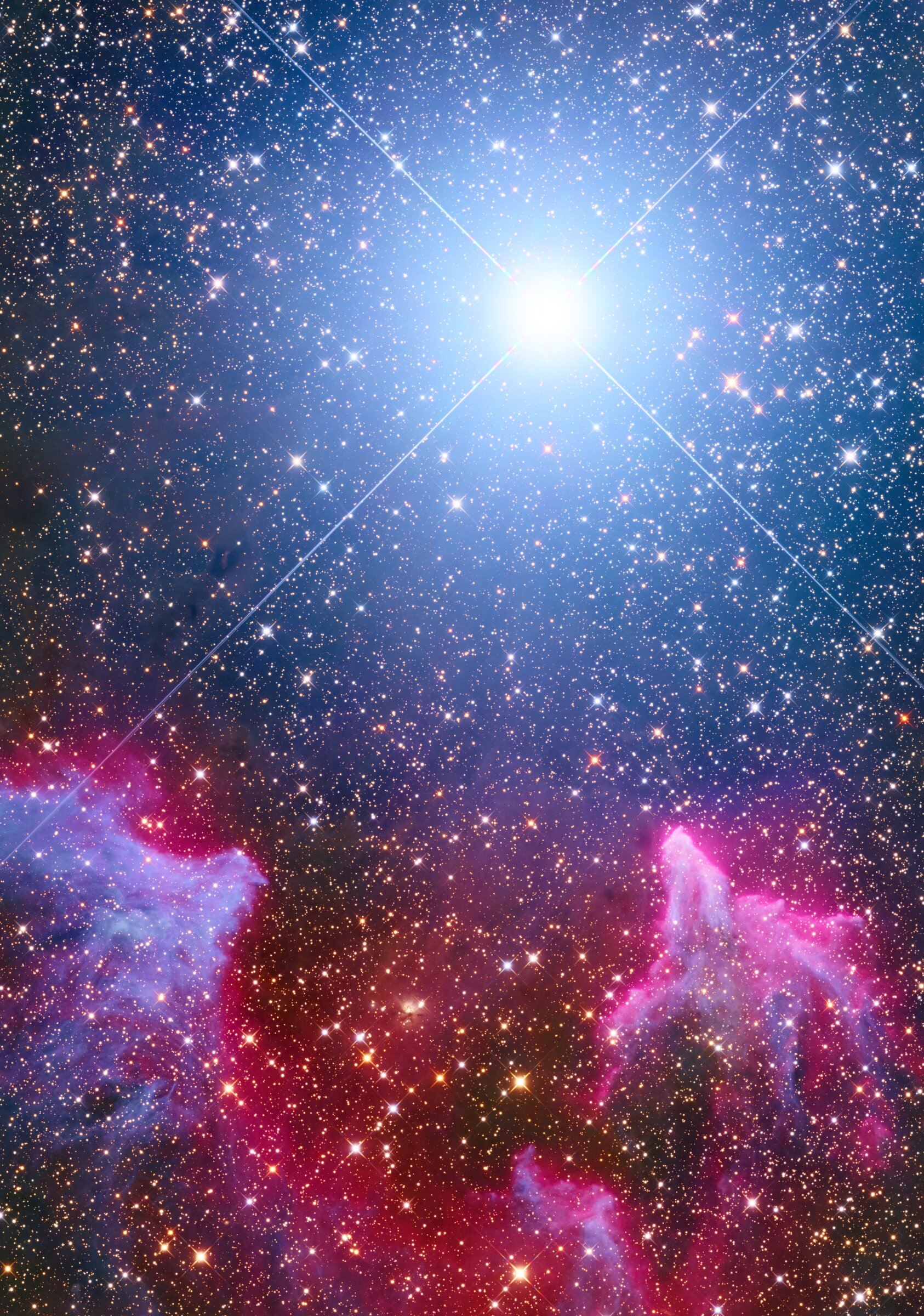
Ghosts in the Light of Navi - γ Cassiopeiae, IC 63 and IC 59
The brilliant blue star in the upper right of the image is γ Cassiopeiae, the middle star of the “W” asterism in the constellation Cassiopeia. Its nickname, Navi, comes from the Apollo program. Astronaut Gus Grissom named the star, which he used during navigation training, after his own middle name, Ivan, spelled backwards.
Navi is a hot, rapidly rotating Be star about 550 light-years away. It spins so fast that it sheds a disk of gas around its equator, and its brightness varies irregularly. Its intense ultraviolet radiation also shapes the interstellar clouds around it.
The traces of this influence appear in the lower part of the image. The two nebulae, IC 63 on the right and IC 59 on the left, are known as the “Ghosts of Cassiopeia.” Navi’s radiation ionizes the edges facing the star, making them glow red in the light of hydrogen. The bluish parts are dust reflecting the star’s light. The clouds are slowly evaporating under this radiation, so the image captures a moment in a slow erosion process on a cosmic scale.
[ EXP ] Exposures
| Filter | Frames | Exposure | Gain | Total |
|---|---|---|---|---|
| L | 90 | 300 s | 100 | 7h 30m |
| R | 30 | 300 s | 100 | 2h 30m |
| G | 30 | 300 s | 100 | 2h 30m |
| B | 30 | 300 s | 100 | 2h 30m |
| Total | 180 | 15h |